
![[Read] The Rise of the Regional Literary Festival](https://cms.wheelercentre.com/media/kaijjkeo/read_desktop.jpg?anchor=center&mode=crop&width=1280&height=720&format=webp&quality=90 "[Read] The Rise of the Regional Literary Festival")
Regional literary festivals are thriving all across the country, bringing writers and readers together in often unexpected ways. Jaclyn Crupi explores why they’re on the rise and what makes them so appealing.
According to Jill Langhammer of Literary Listings, who has compiled the most comprehensive list of Australian literary festivals I could find, 126 of them will take place across Australia in 2026 (10 of these are biennial, six occurring this year, four due again in 2027). Victoria is home to the most, followed by New South Wales and Queensland. I spoke to 10 festival directors and programmers to understand more about what makes them so special – and prolific.
Amongst the longest-running regional literary festivals are Byron Writers Festival, which celebrates its 30th anniversary this August and is also Australia’s largest regional festival, and Mildura Writers Festival, which marked its 31st year in 2026.The newest include Festival of Stories taking place for the first time in Echuca Moama in October this year, Island Readers and Writers Festival which took place in Hobart for the first time in May and Surf Coast Writers Festival which launched at the end of June in Torquay.
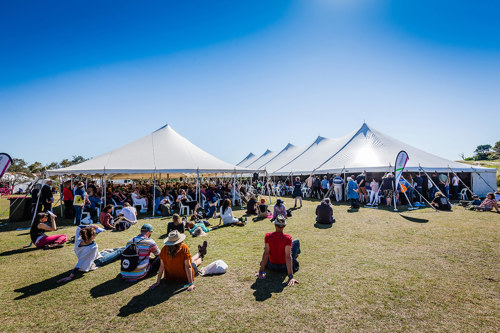
Photo of Byron Writers Festival. Image courtesy of https://byronbay.com
What is it about regional literary festivals that publishers, writers, locals and visitors love so much? What do they offer that city festivals don’t or can’t? The most compelling answer was a strong sense of place and community. Such festivals are deeply shaped by their surroundings, drawing on their local landscape, history, geography, people and food in ways city festivals might struggle to replicate. It is what makes each of them unique. Festival experiences might include winter swims, birdwatching walks and literary lunches showcasing local produce. They embody the place where they are held. As Jessica Alice, Artistic Director of Byron Writers Festival says, ‘It is a festival that’s very much of its place. We’re really leaning into our identity and our connection to this place.’ Corrie Perkin, Founding Director of Sorrento Writers Festival agrees: ‘You must provide your local community with what they want. You have got to be able to read what they want.’
Every author I meet loves attending regional literary festivals, including myself. They offer an opportunity to reach new readers, connect with other writers and become part of a literary community – even if for just a weekend. Bonds form at regional literary festivals in ways they rarely do at their city counterparts. This is at least in part because they are smaller and more contained with all writers staying at the same, usually small, hotel. Camaraderie is almost inevitable. Having breakfast with Gail Jones at Sorrento Writers Festival is a memory I will forever treasure. I particularly loved attending Mildura Writers Festival last year as both a writer and moderator. Invited authors attended all sessions and shared all meals for four days, and I left Mildura feeling I had made some real friendships. It certainly didn’t hurt that many of those meals were prepared by local culinary legend Stefano de Pieri. Festival director Finley Japp puts it well: ‘What audiences can rely on is not just a strong program, but a program that centres genuinely great writing.’ If you like good books and good food, this festival is hard to beat.
Something those of us who regularly attend literary events can easily take for granted is the opportunity to meet the writer after the session in the book signing queue. Few artforms offer such direct access to the creator. As Angela Bennetts, Festival Director of Words on the Waves says, ‘How many art forms embed the fact that you meet the artist after the event? That’s just incredible accessibility. For a book lover to then meet the writer directly and have a quick chat is special. It is really about encouraging that connection between creator and consumer or reader and writer – and also celebrating the books.’
Each year, publishers pitch their writers to festival programmers. Anna O’Grady, Publicity Director at Simon & Schuster, tells me that for each festival, ‘I want to pitch the offer that’s going to resonate with this audience, and I factor in where they are, how big they are and what kind of programming they do.’ While pitches are tailored to every festival, most festival directors and programmers are choosing from the same pool of authors with new books released around the time of their event. What stands out is how each director curates from that shared pool a distinct festival program that caters to and reflects the needs of their communities and region.
The challenges facing regional literary festivals are like those facing arts organisations everywhere – securing funding and protecting artistic freedom. What makes life particularly difficult for regional festivals are speakers’ and artists’ travel and accommodation expenses, as well as bringing in infrastructure – staging, technology, production equipment, etc. –necessary for such events but which are harder to come by easily in some regional areas. They also don’t have budgets for crisis management should they face controversies such as those that recently affected Bendigo Writers Festival and Adelaide Writers’ Week. With higher costs and fewer sources of sponsorship, funding challenges are compounded.
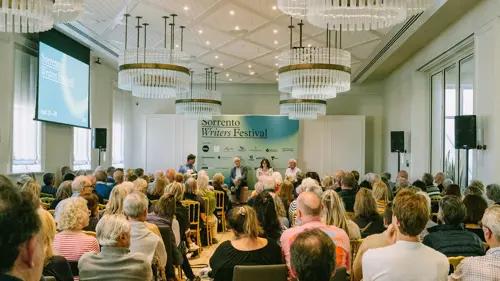
Photo of Sorrento Writers Festival. Image courtesy of https://www.timeout.com/
Growth can present its own challenges. Some regional towns don’t have venues large enough to cater for the popularity of the high-profile authors they can attract. Sorrento, for example, faced this issue when welcoming Irish writer Niall Williams as part of their 2026 festival program – the first year the festival had hosted international writers.
Every festival director I spoke to expressed a wish to attract younger audiences to their festivals and they each had strategies for doing so. In the literary world, millennials are considered this ‘younger audience’, making family programming a great way to engage many readers who are now raising young children and introduce them to everything literary festivals can offer. Anna O’Grady sees opportunities for programming food and gardening sessions that can attract new audiences. ‘I think that books need to be put in the context of life, which is why I love the crossover events with food writers or gardening authors. I love when festivals do that and have a garden writer talking to a fiction writer.’ It is vital that regional literary festivals continue to find ways to be relevant to younger readers and appeal to new audiences.
With literary tourism on the rise, it was interesting to learn how many festivalgoers were locals compared with visitors. For most regional literary festivals, it was a 50-50 mix. However, Louise Omer, Festival Artistic Director of NT Writers Festival, reported that 75 per cent of audience attendees were locals whereas 25 per cent were interstate or international visitors. The NT Writers Festival is about 25 years old and alternates between Darwin and Alice Springs each year. It truly is a festival of the region for the region, which influences the programming. ‘Our audiences love going deep into conversations and seeing how these authors see the world and can usher them into new ways of thinking,’ Louise says.
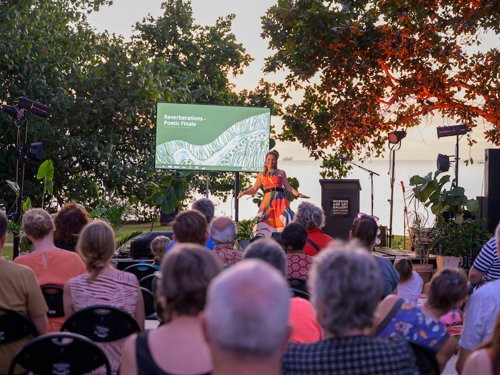
Photo of NT Writers Festival. Image courtesy of https://www.darwin.nt.gov.au/
As Rosemarie Milson, who served as founding Director of Newcastle Writers Festival for 14 years, says, ‘Do not underestimate the importance of regional writers’ festivals in the literary ecosystem.’ While literary programming happens year-round in most cities, the regions are equally hungry for opportunities to engage with writers and ideas. It is worth noting that in most major cities, festival directors often move on after 3–4 years in the job – making Rosemarie’s long tenure in Newcastle all the more remarkable. She is now the Director of Adelaide Writers’ Week, and I cannot wait to see the program she curates for their 2027 edition.
The positive impacts of regional literary festival are easy to see. The way local communities embrace them and volunteer their time and expertise is clear from the moment you arrive at any festival venue. And the economic benefits they bring to their regions is often significant. I cannot encourage you strongly enough to consider planning a trip around a regional literary festival. They possess a quality that is difficult to replicate in the cities. The hospitality will be first-rate, the program is sure to contain sessions that will interest and challenge you, and you’ll discover a region alive with curiosity and a hunger for innovative literary programming.
Supported By

Jaclyn Crupi is a book editor, event moderator, awards judge and bookseller. She has worked in publishing since 2002. Jaclyn has written numerous books for both children and adults.
This piece was commissioned by The Wheeler Centre for our Read channel with support from the Copyright Agency Cultural Fund.
The views expressed by writers on our Read channel are the authors' own and are not representative of a position taken by The Wheeler Centre. We value the creative and intellectual autonomy of our speakers and writers.