

Social reading events, retreats, book doofs and parties are growing in popularity. Jaclyn Crupi wants to find out why we suddenly want to read together.
Call me old fashioned but I like to read my book in my bed or on my couch, with a cup of tea and my little dog beside me. Whenever I leave the house, I always have a book with me and have been known to read in the queue at the post office, while waiting for the dentist, on public transport and pretty much anywhere there’s an opportunity. I actually love it when you’re running late to meet me – instant reading time.
What I have never done is attend an event specifically created for the purpose of reading with other people. To be honest, it has never occurred to me to do this as I have clearly been labouring under the misapprehension that reading is a solitary experience between myself and the book in hand. And if it does extend to an activity involving another person, surely that person is the book’s author and not a roomful of strangers? Oh, how wrong I have been!
Enter the Book Doof: a rave for readers taking place in clubs and venues all around town. Silent reading clubs and parties are proliferating. Libraries are programming book socials that include speed-dating-style rounds of structured book chat (I hosted one at Bargoonga Nganjin, North Fitzroy Library, and it was heartwarming and wholesome). Several bookstores, including Avid Reader in Brisbane, are busting out the cushions and inviting readers to get comfy for an hour of silent reading in the bookshop. They will even lock up your phone for you. It would seem that we want to transform reading solo into reading in community. Reading is suddenly social.
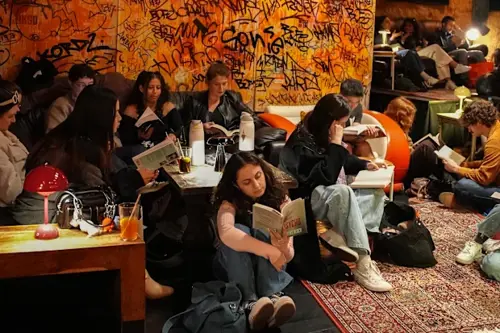 Book Doof. Credit Ella Clarke-King, Alex Weston & Shari Defteros
Book clubs and reading groups have been around for a very long time. In recent decades, they have consisted of groups of friends – often women – meeting monthly on rotation between their homes. The stereotype is that the book is discussed for five minutes before a good gossip session takes over, with wine often involved. Usually, at least three people have not read the book. I have joined such book clubs but left after being described as ‘a bit intense’. I knew it was time to go when I found myself berating the attendees who had not read the book. I am guilty of saying, ‘You have missed out on a fundamental reading experience.’ For the record, the book was Barbara Kingsolver’s The Lacuna, the year was 2009 and I was right.
Social reading is a relatively new phenomenon. Many of the people I spoke to who have started social reading clubs did so after hearing about similar gatherings in Europe and America. Most have been running for a year or less (though it must be said that public libraries have been holding silent reading events for much longer), and we’ll have to wait and see if the popularity endures. Attendees bring whatever they like to read, in whatever form they prefer: there are e-readers, paperbacks, graphic novels, magazines and, yes, even phones. The music is curated, vibes are cosy and all you have to do is sit back and read. Silent crafting activities are also permissible.
Grant Krupp created Book Doof, a silent reading meet-up accompanied by the soothing sounds of artists like Brian Eno and Max Richter. Grant told me, ‘The music has to be slow. I shy away from music that has lyrics. It doesn’t matter what genre it is so long as it doesn’t overwhelm the experience.’ He even runs a customised version of the event, called Club Quiet, featuring live music. Grant’s first Book Doof took place in October 2025, and he thinks it will soon be his full-time job. His theory when creating Book Doof was simple: ‘You don’t need to talk to people in order to have your cup filled.’ Grant is as surprised as I am by the popularity of events like Book Doof, but he sees the appeal as extending the experience of reading into the chance to grow friendship circles, be part of a community and meet new people. ‘I think that people are looking for third places where they can meet more people with similar interests to theirs. There is a yearning for these types of events where they can do the thing that they love the most, but then also meet other people and get to build different friendships.’
Modern book clubs often consist of groups of people who don’t already know each other coming together over a shared love of reading. They are meeting in restaurants, pubs, bars and cafes, where the food is occasionally an equal drawcard to the book chat. Usually, it’s just one person organising the book club, month in, month out. The Tough Guy Book Club was founded in 2012 and is a network of men’s book clubs that meet in local pubs and is run by volunteers. They are generally free to attend unless drinks and nibbles have been provided. The Wheeler Centre has even hosted a few Tough Guy Book Club events. Rachel Furolo started Bookatini in early 2025, with her partner and mother helping to prepare and serve food. They cook a three-course meal and sometimes invite the author to join them. The book-club-and-dinner model Rachel has created is a lot of work and costs attendees $99. Events are capped at 20 people and usually sell out, and Rachel says, ‘All the work melts away when I see people around the table enjoying food and chatting about books. It is such a fulfilling experience.’
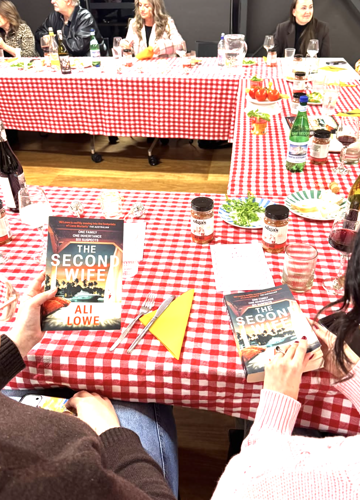
Bookatini book club. Photo courtesy @bookatini_
Joining a book club with strangers would make for interesting book chat. Melbourne author and fellow dedicated reader Emma Hardy (Periodic Bitch) told me she has recently joined multiple book clubs, including some that charge a fee, because she felt her regular book clubs weren’t meeting often enough and she wanted more pace without having to organise it all herself. ‘Plus, it’s nice to hear from people you don’t know and hence can’t pre-empt how they might feel about a book beforehand.’
Silent reading clubs and parties are slightly different again. They are designed for those who love to read but don’t want to do it alone. Snacks seem essential. Attendees bring along their own reading material and settle in for one to two hours of uninterrupted reading. Ania Karolina, who runs Salon Ascot Vale, thinks the success of reading parties could be attributed to how low effort they are. As she puts it, ‘You just bring a book, you don’t have to talk to anyone if you don’t want to, and there is no real stress element of having to speak publicly.’ Ania started Salon Ascot Vale as a book club when she was looking for new social connections after Covid. All her silent reading parties have sold out. She says that some people genuinely come to read, while for others the appeal is being part of the event more than the reading itself. Ania says, ‘It brings me so much joy having a space for myself where I can meet a lot of people, but also seeing people form bonds is a beautiful thing to witness.’ After my conversation with Ania, I couldn’t help but feel like people flocking to experiences such as Salon Ascot Vale are simply responding to a desire for connection in a world that feels so disconnected.
I spoke to a lot of people who have attended such events, and they all explained that doing so did not actually increase how much they read. It was more about doing it collectively. Regular Book Doof and reading party attendee, Giota Niko, put it this way: ‘Reading is a solo activity and when you go to a collective event, you’re in a supportive space and feel part of humanity. It is calming to be amongst others who are reading and focused and not on their phones. You can interact as much or as little as you want, but at the end of the time you feel calmer, more connected and part of a community.’
Anecdotally, from zooming in on photos and videos of reading parties (not creepy, I promise – I am always curious about what people are reading), I notice that a lot of attendees are reading genre fiction – romance, sci-fi, fantasy, romantasy – more so than literary fiction, crime fiction or non-fiction. Grant Krupp backed this up, explaining that he often includes film scores in his Book Doof playlists because ‘A lot of people who come to my events read fantasy or romantasy, and I try to include music that feels like they’re in that experience while they’re reading their book.’
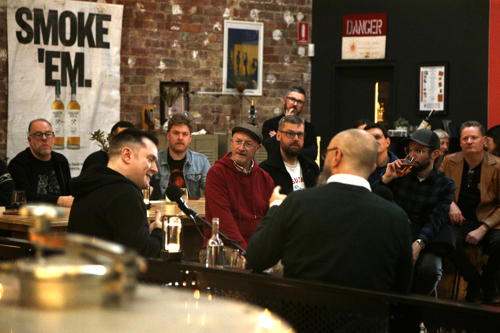 Tough Guy Book Club. Photo by Mark Thomson
Reading retreats are also growing in popularity. Some feature an author-in-residence who curates the books for the experience, while others are run by booksellers or other experienced book professionals. At some retreats, after completing a questionnaire, a selection of books tailored to your personal tastes is curated and awaits your arrival. Often, all meals are provided, and you can read alone in your room or in common areas with others. Anneli McKinnon, who runs To Be Read Retreats, tells me it is ‘Like a yoga retreat but you read instead of doing yoga.’ It sounds like heaven but admittedly can come with a hefty price tag.
In a cost-of-living crisis, it’s interesting to see so many ticketed events selling out for an activity that can be done almost anywhere – and for free. Anyone can take their book to a pub or bar and read. What attendees are paying for, then, is the sense of community and to perhaps meet some like-minded, bookish people along the way.
Connecting with fellow readers through a shared love of books makes complete sense to me. After every great book I read, I desperately want to press it into someone’s hands and say, ‘this book reached something deep in me. Does it feel the same for you, too?’ The very act of reading makes me feel less alone, so doing it in community would only deepen that sense of connection. Maybe next time I pick up my book, instead of heading for the couch, I will make my way to my local library, bookshop, pub, café or club – wherever a large group of people are sitting in silence, reading their books. I suspect it will be obvious that I have found my people.
Supported By

Jaclyn Crupi is a book editor, event moderator, awards judge and bookseller. She has worked in publishing since 2002. Jaclyn has written numerous books for both children and adults.
This piece was commissioned by The Wheeler Centre for our Read channel with support from the Copyright Agency Cultural Fund.
The views expressed by writers on our Read channel are the author’s own and are not representative of a position taken by The Wheeler Centre. We value the creative and intellectual autonomy of our speakers and writers.

Jaclyn Crupi
Jaclyn Crupi is a book editor, event moderator, awards judge and bookseller. She has worked in publishing since 2002. Jaclyn has written numerous books for both children and adults. Her book, Garden Like a Nonno, was shortlisted for an Indie Book Award and longlisted for an Australian Book Industry Award. Her most recent children’s book, The ABC Kids Guide to Loving the Planet, won the Environment Award for Children’s Literature. Jaclyn’s work has appeared in The Guardian, SBS Voices, At Home, The Canberra Times, PIP Magazine and Frankie, as well as the anthology Family published by Text Publishing. Her most recent book is called Planting for Native Birds, Bees and Butterflies.