
![[Read] Pulse Check](https://cms.wheelercentre.com/media/kt5hjp3t/read_-books-1-desktop.jpg?anchor=center&mode=crop&width=1280&height=720&format=webp&quality=90 "[Read] Pulse Check")
In her first piece for [Read], Jaclyn Crupi attempts to take the pulse of the publishing industry by talking to literary agents, publishers and booksellers. Oh, and somehow she works in some book recs, too.
The publishing industry has faced many existential threats (remember when we thought the ebook would be the end of the printed book?) and the longer you work in the industry the better able you are to see patterns and recurring challenges. As Jane Palfreyman, a veteran publisher of over 35 years puts it, ‘It’s an industry that’s always beset by external forces.’ That said, trying to gauge how agents, publishers and booksellers are feeling on the cusp of a global fuel crisis, increased print and distribution costs and a local economy under stress meant that every recent conversation I’ve had about the state of the industry has started in almost exactly the same way: ‘Good, considering.’
Jing Xuan Teo, Co-owner of Amplify Bookshop, is feeling positive about 2026 after ‘a really big start to the year.’ Talking to Xuan reminded me about the incredible gift booksellers offer to readers – the ability to match someone with exactly the right book at precisely the right moment. Her pick of the year so far is The Witch Without Memory by Maithree Wijesekara (you’re welcome).
Joe Rubbo, Managing Director of Readings, also reported a strong start to the year. ‘It feels weird being on the precipice of what could be a huge economic crisis, not to mention all the human suffering that’s happening at the moment, but I think things have been pretty positive. We had a really strong end to last year, too. Christmas was really strong.’
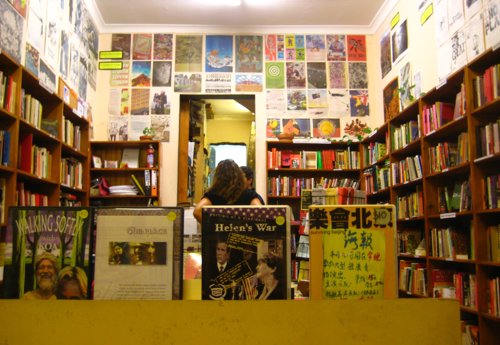
So, that’s good news. We all love indie bookshops and want to see them thrive. The main way we as readers can do that is to buy our books from them. How and where consumers spend money is powerful. As Ann Patchett, Author and Owner of Parnassus Books, writes, ‘Consumers control the marketplace by deciding where to spend their money. If what a bookstore offers matters to you, then shop at a bookstore. If you feel that the experience of reading a book is valuable, then read the book. This is how we change the world.’ Note to readers: Patchett has a new novel out in June called Whistler, which I’ve just read and you should absolutely pre-order it from your favourite bookshop right now (you’re welcome).
Many books are sold to publishers through agents. Pippa Vaughan from Curtis Brown, Australia’s largest and oldest literary agency, was less upbeat when I spoke to her. ‘I think it’s feeling flat,’ she told me. ‘We’re having to work harder than ever to get books and authors out to people to read. I think that publishers are being very conservative. So, we’re seeing that things that we might have sold two years ago – that would have been an easy slam dunk – are not. And debuts are exceptionally hard across all genres now. So that is definitely something that is tough.’
The trickledown effect of this will take years for us to see in bookshops. Everyone agreed that too many books are being published, something that the industry has bemoaned for many years. It must be said that for as long as I’ve been working in the sector, everyone says this and almost nobody publishes fewer books. In fact, more books are being published now than ever (according to data from Bowker’s Books in Print cited in Books + Publishing, about 22,000 new Australian books are published each year) without an increase in book consumers (reading rates are in decline across all demographics). An exception to this is Jane Palfreyman, the legendary publisher who recently moved from Allen & Unwin to Simon & Schuster to start a new imprint, Summit Books. She published eight books last year, including the Stella Prize-longlisted debut short story collection Wait Here by Lucy Nelson (full disclosure: I was one of the judges). This year she will publish about 12 books, including her first cosy crime novel. ‘I always do publish with an eye on the market,’ Jane says. While her focus is fiction, she does have two non-fiction titles planned for 2026. The first is Going On and On by Lucinda Holdforth in which she argues that our ageing population is as great a risk to Australia’s future as is climate change and looming geopolitical risks. It is convincing reading.
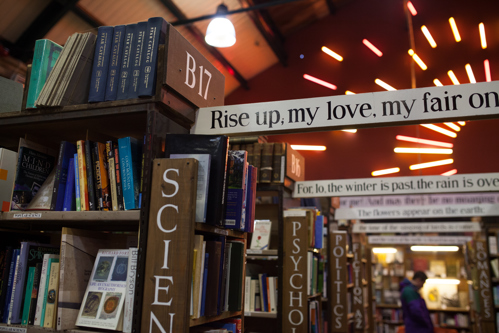
Image by Tom Page
Emily Hart and Margot Lloyd are from the newest publisher on the block, South Australia-based Pink Shorts Press, and feel they can have a stronger impact by consolidating their publication schedule to bi-annually with releases in March and September only. I am intrigued by this strategy, and after the challenging start to the year they’ve had with the cancellation of their March launch following the implosion of the 2026 Adelaide Writers’ Week, I hope it pays off for them. ‘We’re just going to continue leaning on books that are on the shorter side; things that can be a little bit tricky to categorise in terms of genre or form. And we’re both really drawn to a sense of humour as well: something that doesn’t take itself too seriously.’ I recently read Pearls by Tracy Crisp, which Pink Shorts Press released in March 2026 and seems indicative of the kind of books they plan on publishing. Their plucky new venture recalls Hilary McPhee and Diana Gribble, pioneering Australian publishers whose contributions to the industry made it what it is today, and I look forward to seeing what Pink Shorts Press do next. You can imagine how delighted I was to see Hilary McPhee’s memoir Other People’s Words, first published in 2001, updated and rereleased by Melbourne University Press earlier this year.
Fiction writers are particularly good at satirising the publishing industry – one only need read the viral sensation that was Yellowface by R. F. Kuang and/or The Ending Writes Itself by Evelyn Clarke, which is a fun, cosy crime about all the things wrong with the sector. As much as I enjoyed such books, I have been in publishing since 2002, and am perimenopausal and sentimental. I love books, I love the publishing industry, and I was delighted to feel a strong pulse across the sector as I held a metaphorical finger against its metaphorical wrist. As always, when you love something, you need to support it. Emily Hart said it best: ‘Our world would just be a better place if all the people making decisions, read more books.’
What was mentioned time and again in my chats was the perception that during difficult times, people come back to books and reading. ‘I do think that people are going to turn to reading more and more given the sort of global uncertainty and the state of the economy,’ Pippa Vaughan reassured me. Reading is a salve and as Jane Palfreyman puts it, ‘reading is the thing that constantly rewires your brain. It’s the absolute antidote to all the algorithms and all the mind-numbing and mind-emptying effects of social media.’ I wholeheartedly agree with them. Reading can be an act of resistance against algorithms designed to steal your focus and waste your time. It can also be an act of love; for yourself, for an author, for an industry. Books offer solace; we can find comfort between their pages and we can then press them into the hands of others, offering them the same. How deeply human an impulse.
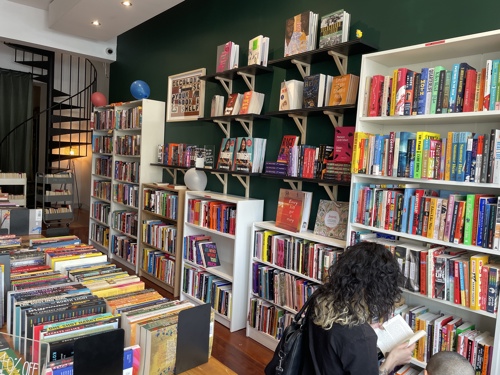
Amplify Bookstore by Teo Jing Xuan

Jaclyn Crupi is a book editor, event moderator, awards judge and bookseller. She has worked in publishing since 2002. Jaclyn has written numerous books for both children and adults.
This piece was commissioned by The Wheeler Centre for our Read channel with support from the Copyright Agency Cultural Fund.
The views expressed by writers on our Read channel are the author’s own and are not representative of a position taken by The Wheeler Centre. We value the creative and intellectual autonomy of our speakers and writers.