

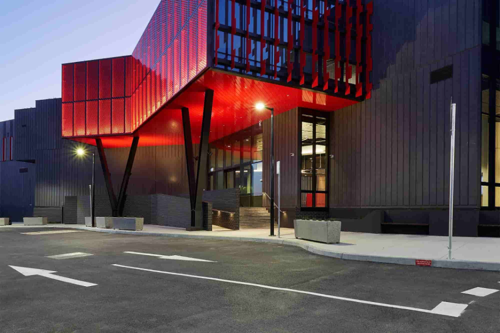
In 2021, in a pocket of Melbourne's inner west still shaking off its industrial past, Maribyrnong City Council's Greens councillor Bernadette Thomas and Labor councillor Cuc Lam moved and seconded a motion that, in hindsight, reads like a punchline: a six-hectare data centre across the road from homes in West Footscray could go ahead, so long as the developer threw in a bike lane.
That is how little the council and any of us understood what was coming. In the councillors' defence, there were few community objections (five to be exact) to the NEXTDC data centre at the time, and the vacant site, a former chemical factory that had previously burned down, seemed better suited to a hyperscale data centre.
Source: NEXTDC
Five years on, the disruption is relentless.
Residents describe road closures that drag on for months, a constant stream of trucks, nature strips torn up and paved with crushed rock, repeated power outages, diesel generators running late into the night and a low hum that seeps through bedroom walls. On one street, neighbours have installed white noise machines just to sleep. For local Labor MP Katie Hall, the growing anger has become a political headache. In a seat the Greens came within four percentage points of taking in 2022, a backlash that once looked parochial is now a genuine threat. She has been forced to write to her own government's planning minister to request a pause in the expansion, pending a review into an independent cumulative impact assessment.
'Residents have been rightfully frustrated by the construction impacts of the existing data centre,' Hall said.
Yet NEXTDC has been feted rather than fenced in. Last month it took home the Innovation Award at the inaugural Data Centres Australia Excellence Awards, sponsored by the state government's own investment agency, Invest Victoria. And despite all of this, growth is on the horizon. NEXTDC is looking to expand the site to 10 hectares and invest $1.5 billion in a campus already operating as close as 15 metres from homes.
I live in Braybrook, a short drive from the centre, and pass it often. At dusk the grey monolith looms over the weatherboards, new 15-metre power poles are rising along the street, and with the window down you can hear its droning hum. Currently steady stream workers in hi-vis can be seen, going in and out the site and redirecting traffic on the main road. While, this economic activity is precisely the selling point of the data centre proponents, the irony is that once construction finishes most of the jobs will have gone with them, as the centres will require significantly low numbers of people to run them.
Our digital lives now live in data centres, which power the conveniences of modern life, from online banking to digital driver's licences to, much to our collective dismay, the QR-code menu at your local restaurant.
However, the explosion of large language models like ChatGPT and Claude has made the need for mega centres greater than ever. In barely five years, artificial intelligence has gone from a curiosity to the organising ambition of the richest companies on earth. Amazon, Alphabet, Meta and Microsoft will spend around US$725 billion this year, mostly on chips and the buildings that house them, each racing to tighten its grip on a dubious market.
Australia's energy market operator now forecasts data centres will consume 13 per cent of power demand in the national electricity market by 2036, a level it had not expected until after 2050 only a year earlier. The world has moved too far, too quickly, leaving the people beneath it to absorb the shock.
The men steering this boom are something out of satire: billionaires who speak breathlessly of god-like intelligence while their turbines rattle the windows of ordinary neighbours. Some of them even admit AI could wipe out humanity, then carry on building it anyway. Their ambition is boundless; their sense of obligation to the places that host them, close to nil.
The data centre is the perfect monument to the age – vast, windowless, humming and owing nothing to the street it stands on.
Source: Star Weekly/ Cade Lucas
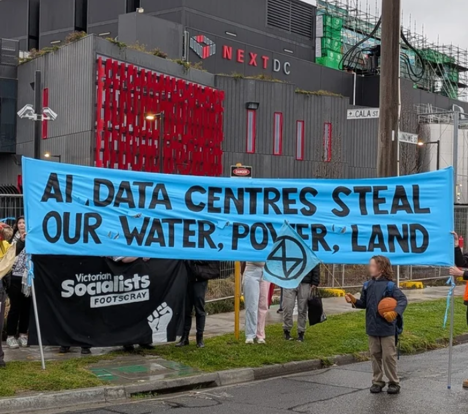
Yet what they didn't account for was the fierce community pushback, from Melbourne's suburbs to small-town America. In Melbourne alone, local WhatsApp groups from Clyde North to West Footscray to Broadmeadows are abuzz with people from every walk of life, veteran environmentalists alongside young people who have never protested anything in their lives. Residents' group Citizens of Tottenham has lodged a formal demand for remediation from the operators of NEXTDC's West Footscray centre and a second approved data centre nearby, seeking compensation for lost amenity, a community benefit scheme and relocation assistance.
Community efforts have proven to be a formidable force due to their ongoing protests resulting in NEXTDC shares plummeting by 40 per cent, prompting the date centre behemoth to slash its earnings forecast and pause construction spending.
On Sydney's lower north shore, Lane Cove shows what that momentum can achieve. Residents there lodged 359 objections to Goodman's $1.2 billion Project Mars, planned about 20 metres from homes, against just seven for a neighbouring centre approved in 2021. Last month Goodman withdrew the plan, after admitting to a Senate inquiry that it had failed to win a social licence.
Abroad, Americans are further down this road. In Memphis, Elon Musk's xAI ran gas turbines without air permits to power its Colossus supercomputer, prompting the civil rights group NAACP to demand the centre be shut down. Across the state line, Mississippi residents have filed a class action over near-constant noise and vibration. And they are winning: according to Data Center Watch, opposition groups have doubled to 833, blocking or delaying 75 projects worth US$130 billion in the first three months of 2026 alone.

Source: Wikimedia Commons/ Daniel Torok
For a state Labor government facing a November election, it has been an embarrassing blunder, and one it is now scrambling to correct with election promises. Former premier Jacinta Allan vowed Victoria would be 'ruthless' in chasing data centre jobs, and said the state wanted to be the clumsily worded 'data centre centre'. Now her successor, Ben Carroll, is promising to ban data centres from residential zones and impose a 150-metre buffer from homes. In Canberra, Anthony Albanese has promised mandatory national standards requiring large data centres to underwrite their own new power supply, minimise water use and pay for the infrastructure they need.
But the new rules are not retrospective. Projects already approved like NEXTDC, or still under assessment, are exempt.
And the frontier keeps moving. South of Broome, a joint venture part-owned by Karajarri Traditional Owners, which is projected to open in 2032. Its chief executive is already courting Singaporean companies, so the data it serves may not even be ours. Yet it would set a vast, partly gas-backed industrial beast along an undeveloped stretch of the Kimberley.
Stand on Indwe Street in West Footscray at night and you understand what these buildings are really asking of us: to accept the hum as the price of progress, and to treat sleep, quiet, open country and a say over our own streets as luxuries a modern economy can no longer afford.
And who is asking? Governments asleep at the wheel, stirred only by the promise of growth. As Booker-Prize-winning writer Richard Flanagan described, the federal government has been ’too easily dazzled by power’ while they were being courted by AI companies. On the contrary, Spring Street needed less perceived charm, offering our state and suburbs up to tech companies in exchange for a sugar hit to the economy and a shot at re-election.
It is in that travesty that while our governments drool over the numbers, the work of resistance falls to ordinary people, most of whom have yet to see AI make any real difference to their material lives.
The industries that once filled the west were noisy and dirty too, but they gave something back. The Sunshine Harvester Works built a suburb around its factory gates, Kinnears Ropeworks employed Footscray families for generations, and the Newport railway workshops trained whole lineages of tradespeople. Those places fashioned towns and fed households.
A data centre offers a hum, a handful of jobs and a promise of progress nobody can quite point to.
Courtesy of The Wheeler Centre
So it is ordinary people, from Footscray to Lane Cove to Memphis, retirees, parents and students, who are giving up their evenings, weekends and working hours to slow a juggernaut nobody in power seems willing to steer.
Against buildings designed to need almost no people at all, their stubborn, unpaid, very human resistance is the one thing the machine did not account for.
Supported By

Najma Sambul is a Melbourne-based freelance journalist living in the inner west suburbs.
This piece was commissioned by The Wheeler Centre for our Read channel with support from the Copyright Agency Cultural Fund.
The views expressed by writers on our Read channel are the authors' own and are not representative of a position taken by The Wheeler Centre. We value the creative and intellectual autonomy of our speakers and writers.
Header image source: Wikimedia Commons / Chad Davis

Najma Sambul
Najma Sambul is a Melbourne-based freelance journalist living in the inner west suburbs. She has previously worked for both The Age Newspaper and the ABC. While at the Age, she covered local government across Metropolitan Melbourne and Regional Victoria tracking the decisions that determine how neighbourhoods grow, who gets a say, and who doesn't.
Her experience in local government, planning and council-related include breaking news, in depth feature reports and opinion. Najma reported internationally for the ABC's Asia Pacific Newsroom with a special focus on diaspora communities in Australia. Her bylines have also appeared in Agence France-Presse, The Guardian Australia, HuffPost Australia, Eureka Street and more.
She believes good journalism means showing up with curiosity, not assumptions, and aims to report with accuracy, fairness and a human-centred lens — especially for communities that are often talked about rather than talked to. She holds herself accountable to the people and places she covers and welcomes the same scrutiny she applies to others.