

I used to have a Barack Obama magnet on my fridge.
It was 2016. I had just turned 18 and had done my first big trip travelling the US. At the time, Obama was one of my biggest heroes. I grew up in a family that rarely spoke about politics, so, as an outsider, I saw him as a symbol of hope.
You may call me naive, and I was. My dream was to become a diplomat. I purchased a cheap United Nations flag online and hung it on my wall, dreaming of my role in an exciting future.
A decade on, my views could not be more different to those of that young girl. Like much of the world, I have become far more critical.
My generation has been failed, repeatedly, by our governments. Leaders bend the knee to Trumpian authoritarianism. AI devours art, thought and creativity. Mass surveillance and atrocities are normalised. Politicians shake hands with fossil fuel lobbyists as we hurtle towards climate collapse.
Young people’s calls for action have been ignored. So we get louder. Around the world, young people are taking to the streets: from France, to Albania, to Italy, to India.
We are driven by urgency rather than optimism. It’s hard to imagine a future when we can so clearly see the end. And so, we act – because we feel the fire at our feet.
A trust crisis
The younger side of my generation has only known decline: the rise of fascism, division, and erosion of democracy. Studies find that young people are less satisfied with democracy and have less trust in government compared to older generations. Only 15 per cent of Australian young people said they have ‘a lot’ or ‘some’ trust in politicians.
A recent The New York Times article titled ‘What is Life Going to Be Like in 2050?’ interviewed more than two dozen ten-year-olds about the future. The responses are revealing. A select few:
'Companies will start using A.I. instead of human workers. That’s probably going to cause a pretty big job shortage.'
'Now we paint, we draw. In the future, people will look back and say: “Oh my God, we used to paint? We used to draw?” I hope that doesn’t happen, but I think it might.'
'There’s bound to be a war. The war against Iran right now is bound to spark a couple more wars. I really hope it doesn’t start World War III.'
The answer to why young people have profoundly low trust in our politicians and democracy is quite simple: we have given them no reason to trust.
Young people are inheriting a series of catastrophic shifts where leaders have utterly failed to meet the moment. On the economic front, young people’s wages cannot keep up with rising costs. Our job economy is shifting before our eyes, with more and more entry-level-roles being passed off to A.I.
Next is housing affordability, which has become near impossible for young people who cannot rely on their parents. The average house in Australia used to cost just over nine times the average household income per capita in 1990; by 2024, that figure had risen to 16.4 times. Young people who are lucky enough to be able to live with parents are staying home and saving up, missing out on the independence and freedom of their 20s that are so crucial to how we understand the world.
Unsplash: Nikolas Gannon
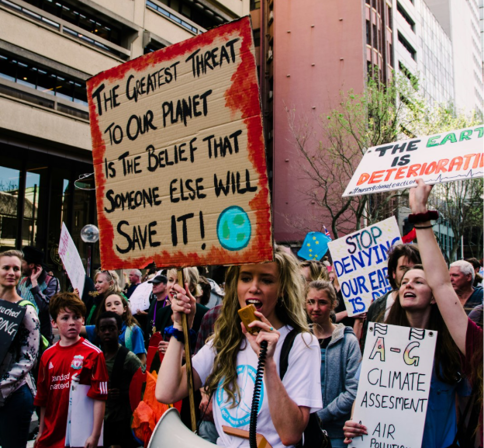
Climate change is also a major concern. As the world overshoots the limit of a 1.5-degree increase, my generation has watched leader after leader wring their hands and pretend to be powerless despite their mandate to care for the Australian people. We will live with these devastating and negligent failures. Underneath nice political speeches and handshakes, we see that we are heading towards impending planetary collapse.
Young people are also more interconnected than ever before. As digital natives, we care strongly about what happens beyond our borders; and particularly crises in which many young people view our government as complicit. We follow these people online and see their perspectives on the ground. The mode is imperfect – rage-focused algorithms – but our dissatisfaction extends beyond what is happening within our borders.
What politicians are getting wrong
Young people’s distrust in politics is seen as a problem to be managed and not a reflection on politics itself.
Governments too often treat young people as a faceless plot device. We appear in policy as a group to be protected: from social media with the under-16s ban, or from the manosphere through the proposed opt-out algorithm. These measures may well help, but they also reveal a paternalism that sees us as people to be shielded rather than citizens with material, complex concerns of our own.
There is little to show that politicians have meaningfully responded to young people’s voting concerns, including on housing, climate change and inequality. While the federal government did restrict negative gearing, critics argue that the grandfathering exception means that it has little immediate impact for young people today. The underlying reason that governments have failed young people is that they are afraid to do necessary but unpopular things.
My generation’s fears require real political courage that can deal with the new world we are living in.
Courtesy of The Wheeler Centre
The tough reality is that real climate action will affect our economy and our ways of consumption. We cannot endlessly extract. Real housing affordability will affect those with properties, mainly older generations. These choices are not politically rewarding and may very well be unpopular. They are, nevertheless, essential for our long-term future.
Governments fear this and instead tinker around the edges so they do not lose the next election. But if they fail to change much at all, what is the purpose of governing? At what point is Australia asleep at the wheel?
Most frustratingly, some groups in politics believe that young people are simply not being marketed to hard enough. The previous federal election was marked with campaign videos using TikTok trends and memes; as if parties’ failure is relatability rather than performance.
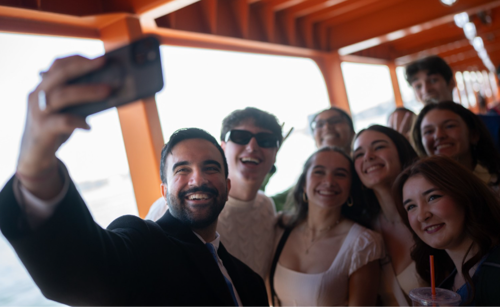
Leaders who are popular with my generation give some insight into how to genuinely reach young people. New York Mayor Zohran Mamdani is the obvious example. Gen Z proved instrumental to his campaign, with over 75 per cent of young voters supporting Mamdani.
Source: flickr/ @nycmayoroffice
Mamdani’s success points to something deeper than a slick media campaign. Mamdani ran a people-powered campaign and spoke to issues that establishment politicians were terrified to acknowledge, standing with integrity alongside a policy platform that made a material difference to people’s lives.
Surprisingly, Canada’s Prime Minister Mark Carney also enjoys the highest approval rating in Canada’s Gen Z above all other prime ministers. While not all young people will agree with all of Carney’s policies, his popularity has particularly grown following his willingness to challenge the United States and pass policies that protect Canada’s sovereignty and long-term future.
Carney and Mamdani, in their own ways, demonstrate political bravery and an ability to meet the political moment.
In contrast, Australia’s politics often feels like the emperor’s new clothes, where politicians speak to a world that no longer exists. Increasingly, we are also seeing political appeals to nostalgia and a new MAGA (Make Australia Great Again). None of these approaches are correct. It is impossible to return to the past; we must look ahead.
We are entering a new world. A world of all but collapsed multilateral institutions. A time of growing authoritarianism and tech surveillance. A growing disillusionment with capitalism mixed with an ever-shifting job landscape with the rise of AI.
The question is not how to restore young people’s trust in politics. It’s whether politics has earned the trust of young people.
Time and time again, that answer is no.
Supported by
Yasmin Poole is an award-winning speaker, writer and youth advocate.
This piece was commissioned by The Wheeler Centre for our Read channel with support from the Copyright Agency Cultural Fund.
The views expressed by writers on our Read channel are the authors' own and are not representative of a position taken by The Wheeler Centre. We value the creative and intellectual autonomy of our speakers and writers.

Yasmin Poole
Yasmin is an award-winning speaker, writer and youth advocate.
A Rhodes Scholar, she studied at the University of Oxford, where she researched how governments can create better policy for communities that slip through the cracks across race, gender, disability and class.
Yasmin is also an award-winning media commentator and has spoken on ABC News, Q+A, TEDx, SXSW and the Festival of Dangerous Ideas. She sits on the board of several NGOs including OzHarvest, the Australian Republic Movement and Democracy in Colour, and serves as Plan International Australia’s National Ambassador, advocating for young women’s human rights around the world.